August 13, 2026 · By M. Usman
Getting Meta Ads Traffic But No Shopify Sales? The Pakistan-Specific Reasons Most Guides Miss
You're spending money on Meta ads, people are clicking, and your Shopify dashboard still shows almost nothing. Here's the short version: first separate a measurement problem from a real conversion problem. For Pakistani stores specifically, that means checking Meta/Shopify tracking, off-site WhatsApp orders, and COD confirmation and delivery — and only then the usual product-page, offer, mobile, and checkout problems every generic guide already covers. (New to Meta ads entirely? Start with Meta Ads for Beginners in Pakistan first — this post picks up from there.)
First, separate a measurement problem from a real one
Shopify orders and Meta-attributed purchases will not always match exactly — the two systems use different attribution and reporting logic, and Shopify itself is upfront that different analytics tools can legitimately disagree. So don't panic over a small gap. But if Shopify is recording real orders while Meta's Purchase event is missing entirely or clearly under-reporting, check your Meta integration: Events Manager diagnostics, pixel setup, Conversions API (CAPI) / data-sharing configuration, and event deduplication — before you touch the campaign itself.
Browser-only pixel tracking can miss events for a few reasons: ad blockers, page-load failures, and general browser restrictions. Shopify's own Meta integration can layer the Conversions API alongside the pixel — server-to-server events aren't blocked by browser-based ad blockers the way pixel-only tracking is — which is why I check the store's data-sharing level before treating Ads Manager as the full picture. If Shopify and Meta broadly agree and both show close to zero, the problem is real — keep reading.
The part every generic guide skips: Shopify Payments doesn't exist in Pakistan
Pakistan isn't on Shopify's list of supported Shopify Payments countries. For online card or digital-payment processing, Pakistani merchants need a compatible third-party provider — options include integrations like Safepay, which advertises both hosted and onsite Shopify checkout — and can also offer manual payment methods like COD or bank transfer directly through Shopify's own built-in manual payment options. That single fact changes your diagnosis in two ways most advice never accounts for.
One: a COD order isn't collected revenue yet. Published estimates of how much of Pakistani e-commerce runs on COD differ depending on what's being measured — the U.S. International Trade Administration cites industry reports putting it at 95% of ecommerce companies receiving payment via COD, while PCMI's analysis estimated COD at 75% of ecommerce payment volume in 2024. Either way, COD is unusually central to the Pakistani funnel. Shopify handles COD as a manual payment method — the order gets created, but payment and successful delivery still sit further down the funnel, and manual payments aren't captured automatically the way processed online payments are. If you're only looking at "orders placed" as your conversion number, you're measuring the wrong stage — check your confirmed and delivered rate too, not just placed orders, before concluding your ads aren't working.
Don't use one "conversion rate" for a COD store — the meaningful funnel has more steps than a card-checkout store's does:
- Sessions → Add to cart — are people even engaging with a product once they land?
- Add to cart → Checkout started — where price or shipping cost often causes drop-off
- Checkout → COD order placed — your Shopify "conversion rate" usually stops measuring here
- Placed → Confirmed — did the customer actually confirm the order when contacted?
- Confirmed → Delivered — courier failures and refusals happen here
- Delivered → Kept (not returned) — the number that actually matters for revenue
A store measuring only the third step (orders placed) and comparing it to a card-checkout benchmark is comparing two different things.
Two: some real buyers never check out on Shopify at all. In the Pakistani stores this shows up in, a customer clicks the ad, browses the site, then moves the conversation to WhatsApp or Instagram DMs before ordering instead of finishing Shopify's checkout. Unless you've deliberately connected that outcome back to your analytics or Meta's measurement setup — Meta's Conversions API does support business-messaging events from WhatsApp and Messenger, so it's not necessarily invisible if you've wired it up — Shopify's normal checkout reporting won't tell you the whole story on its own. Before concluding your funnel is broken, check whether people are messaging instead of checking out. If yes, that's revenue your dashboard isn't showing you by default, not evidence the ads failed.
The generic reasons still apply too — check these next
Once you've ruled out tracking gaps and the COD/WhatsApp blind spots above, the usual causes are still real:
- Mobile experience — check your own device breakdown first; if most paid sessions are mobile, walk the entire journey yourself on the same kind of phone your customers use: ad → landing page → variant selection → add to cart → shipping → address fields → payment/COD → confirmation
- Page speed — slow-loading product or checkout pages lose buyers before they see your offer
- Message match — does the landing page say the same thing the ad promised? A mismatch is one of the most common silent conversion killers
- Payment friction — third-party payment setups vary in how integrated they feel; test the actual mobile checkout yourself instead of assuming a gateway is frictionless because it technically works
Where you actually stand, roughly
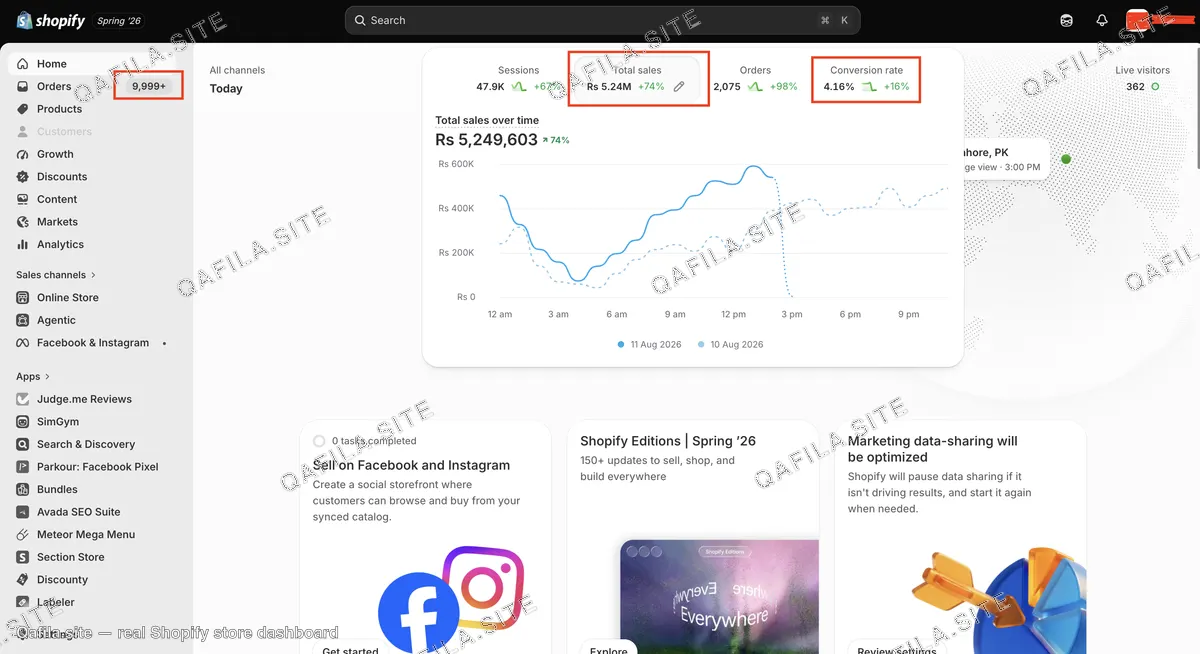
As a rough reference point, Littledata's benchmark of 2,800 Shopify stores (data from 2023, not fresh 2026 numbers) found a 1.4% average conversion rate, with stores above 3.2% in the top 20%. Don't treat this as a 2026 Pakistan target — Shopify's own current guidance makes the same point: a universal conversion rate is a weak measure on its own, because category, price point, device mix, and traffic source all change the number. A COD-heavy store measuring "orders placed" isn't measuring the same thing as a card-checkout store measuring "orders paid," so don't panic-compare your raw number against this without accounting for that difference first.
The actual order to check things in
- First, does Shopify's order count roughly match what Meta reports? If Meta's Purchase event is clearly missing or under-reporting relative to real Shopify orders, fix tracking (Events Manager, CAPI, deduplication) first — everything else is guesswork until this is right.
- Second, are people messaging you on WhatsApp/Instagram instead of checking out? If yes, that's revenue your dashboard isn't showing you by default — track it separately, don't blame the ads.
- Third, are COD orders being placed but not confirmed or delivered? Check your real confirmed/delivered rate, not just "orders placed."
- Only after those three are ruled out, look at mobile experience, page speed, message match, and payment-gateway friction.
This is the same order I walk through with batches inside Qafila, live, on a real store — not slides, an actual Shopify admin and a real Meta Ads Manager open on screen. If you're still deciding whether a Shopify course is even worth it before you get this far, here's what a good one should actually teach you.

M. Usman
Founder & Instructor, Qafila
I've spent 4+ years managing over $1 million in ad spend across Meta and TikTok for e-commerce and service brands worldwide. I run my own dropshipping and private-label stores, and as a CRO expert I've built Shopify stores for some of Pakistan's leading D2C brands. As a creative strategist, I research and produce AI-generated ad creatives daily; as a data analyst, I scale accounts using my own custom decision-making frameworks — powered by AI.
Follow Qafila on Instagram →Want to learn this exact diagnostic hands-on, live, on a real Shopify store and a real Meta Ads account?
See the next Qafila batch